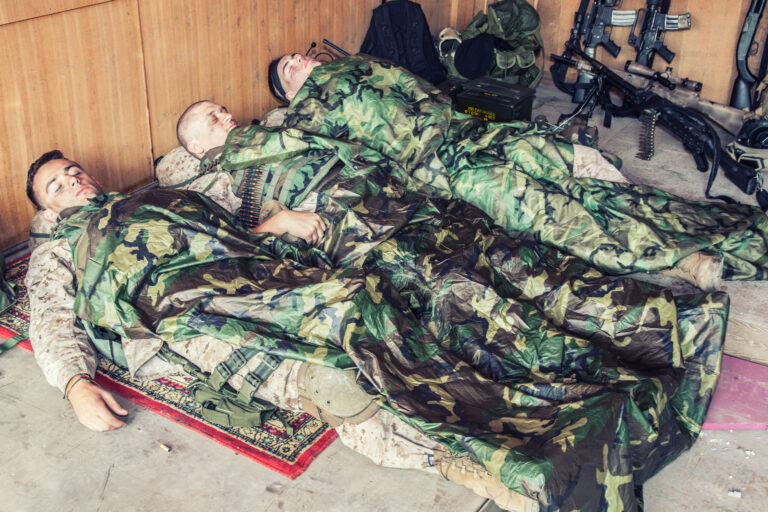

The first thing that goes after deployment is sleep. Not because nothing is wrong — because something is right and the body has not figured out how to let it stay right. The threat is over but the vigilance is not. The body learned to wake at small sounds, scan for danger before settling, and never sleep deeply enough to lose track of the perimeter. That training does not unlearn itself in the time it takes to get home.
This article is for veterans whose sleep has not come back the way they expected it to — and for the spouses, partners, and family members who are watching it happen and trying to figure out what helps.
The Short Answer: Post-deployment insomnia is not regular insomnia. It is the body still running on a combat sleep adaptation — light sleep, fast wake-up to small noises, hypervigilance loops at night, intrusive replays of deployment events. Standard sleep hygiene tips (“dark room, no screens, regular bedtime”) help around the edges but do not address the underlying nervous-system pattern. What actually helps: treating the underlying hypervigilance (often a PTSD or sub-threshold PTSD picture), medication options that target sleep specifically in trauma-related insomnia (not just general sleep aids), structured trauma-focused therapy, and changes to the bedroom environment that reduce perimeter-scanning. This is treatable. The standard “see a sleep doc” pathway often misses the trauma piece entirely.
If you are a Las Vegas-area veteran whose sleep has not come back, MindWell’s veteran sleep disorder treatment is built around exactly this picture. Call (702) 530-2549 or schedule online.
Why Combat Changes the Way You Sleep
Sleep in a combat environment is not the same biological event as sleep at home. The body learns a different sleep architecture — lighter, shorter cycles, faster transitions to wakefulness, increased baseline cortisol, increased baseline heart rate during sleep. NIH’s Brain Basics: Understanding Sleep walks through how typical sleep stages work, which is the baseline these combat adaptations diverge from. This is not a malfunction. It is exactly what the body should do when sleeping in a place where being unconscious is dangerous.
The problem is that this adaptation does not shut off when you get home. The nervous system is still running on the old pattern even though the conditions have changed. Months or years later, the patterns that were adaptive in Iraq, Afghanistan, or any other operational environment are still running in a Henderson bedroom.
Common patterns that show up:
- Falling asleep is fine, staying asleep is not. The body is still set to surface every 90 minutes to check the perimeter.
- Small sounds wake you instantly. A dog moving in the next room, a partner shifting in bed, a car door across the street.
- Sleeping in a defensive position. Back to a wall, line of sight to the door, weapon nearby.
- Intrusive memories at sleep onset or in REM. Replays of specific events, sometimes in vivid detail, sometimes as fragmentary sensory memories (a smell, a sound, a temperature).
- Waking with the heart pounding for no apparent reason — the body’s threat system firing without an external trigger.
- Avoidance of sleep itself because of what happens when you go to sleep.
Almost every veteran who has been in a combat zone has some piece of this picture. The question is not “is something wrong with you” — the question is whether the pattern has become disruptive enough to need treatment.
This Is Not the Same as Civilian Insomnia
Civilian insomnia treatment is built around a different problem. The standard pathway — sleep hygiene, melatonin, sometimes a short course of trazodone or zolpidem — works reasonably well for stress-driven, anxiety-driven, or schedule-disrupted insomnia in someone whose nervous system is fundamentally calibrated for safety.
It works less well for combat-pattern insomnia because the underlying issue is not sleep behavior or sleep environment. The underlying issue is that the threat-detection system is still running. Treating the sleep without treating the threat-detection system is like trying to dim a light by closing your eyes.
The distinction matters because the wrong treatment can be actively counterproductive. A standard sleep aid that knocks you out without addressing hypervigilance can produce nights where you sleep through actual perimeter-scanning instincts the body is still running underneath the medication — which feels worse, not better, the next day. Some veterans describe being “trapped” in this kind of medicated sleep.
What Actually Helps
The treatments that work for combat-pattern insomnia tend to fall into four categories:
1. Treating the underlying hypervigilance
If the trauma picture is significant — full PTSD, sub-threshold PTSD, or combat operational stress that has not resolved — treating that is the most effective way to fix the sleep. Sleep usually improves when hypervigilance comes down, even before the sleep itself is targeted directly. Trauma-focused therapy (CPT, EMDR, prolonged exposure) and medications appropriate to the trauma picture often produce the largest sleep gains.
2. Sleep-specific medications that match the trauma profile
Some medications are particularly useful in trauma-related insomnia and not just general insomnia:
- Prazosin — originally a blood pressure medication, repurposed for trauma-related nightmares. Reduces noradrenergic activity at night. Works particularly well for the “wake up with the heart pounding” pattern.
- Trazodone — often used at low doses for sleep onset and maintenance. Less direct effect on hypervigilance but useful for general sleep restoration.
- Mirtazapine — sometimes used at low doses for sleep, particularly when there is overlap with depression or weight loss.
Medication choices are individual. The provider matches the medication to the specific pattern of the patient’s sleep difficulty, not just “veteran with insomnia.”
3. Structured trauma-focused therapy
Cognitive Processing Therapy (CPT), Eye Movement Desensitization and Reprocessing (EMDR), and Prolonged Exposure (PE) are the three most-studied trauma-focused therapies. They are time-limited (typically 8-15 sessions) and target the trauma directly rather than the surface symptoms. Combat PTSD treatment usually integrates therapy with medication management when both are appropriate.
4. Bedroom-environment changes that reduce perimeter-scanning
Smaller and unscientific but often useful:
- Bedroom layout that puts the bed where you can see the door without having to roll over
- White noise to mask the small sounds that trigger arousal
- Blackout curtains so headlights and car movement do not register as motion
- Decisions about firearms in the bedroom that are made carefully and not in the middle of the night
- Pets that are part of the threat-detection system (a dog that wakes for real intruders) often help more than they hurt
These changes are not a substitute for treatment. They reduce the surface triggers but do not address the underlying pattern.
Why “Just Use the VA” Often Doesn’t Work
The VA mental health system can be excellent. It can also have wait times measured in months, providers who rotate too quickly to build a relationship, and intake processes that veterans abandon halfway through. Many veterans in southern Nevada have either tried the VA path and given up, never tried it because they heard from friends it was not worth it, or are using VA care for some things but want a private option for psychiatric care specifically.
That choice is reasonable. Private psychiatric care for veterans is not a betrayal of VA care — it is often a complement to it, particularly when a veteran wants faster access, longer visits, or a provider whose practice is veteran-focused without being VA-bound.
What If Sleep Is Already Affecting Everything Else
By the time most veterans seek help for sleep, the sleep issue is no longer the only issue. Chronic insomnia produces:
- Daytime irritability and short fuse — particularly in the relationships that matter most
- Cognitive slowing, memory issues, attention problems that get misread as ADHD
- Mood symptoms — depression, anhedonia, hopelessness — that may have started as a consequence of sleep deprivation
- Increased substance use as self-medication, particularly alcohol or cannabis
- Physical health effects — blood pressure, weight, immune function
Treating the sleep often unwinds these in a way that no other intervention does. A veteran who sleeps for the first time in three years often describes the change as “getting myself back” — not because the trauma has been resolved, but because the body finally has the resources to function again.
What If the Trauma Was Not “Combat” in the Strict Sense?
This question comes up often. Many veterans with deployment-related sleep issues did not see direct combat. Drivers, mechanics, medics, intelligence personnel, and support roles often have meaningful operational stress without “combat” in the kinetic sense — and the sleep adaptation is the same. The body does not need a firefight to learn to sleep light. Sustained operational tempo, ambient threat, and constant low-grade activation produce the same nervous-system pattern.
The clinical reality: post-deployment insomnia does not require a trauma “diagnosis” to be treatable. The pattern is the pattern, regardless of what label fits the precipitating events. Veteran mental health in Las Vegas at MindWell is built around this — treating the experience the veteran actually had, not the experience the diagnostic checklist expects.
How to Start the Conversation With a Provider
If you have not had this conversation before, useful framing:
- “I have not slept well since I came home from deployment.”
- Specific patterns: “I wake up at 3 AM with my heart pounding.” “I can’t sleep unless the door is locked and I can see it from the bed.” “I have nightmares about specific things from deployment.”
- What you have tried: melatonin, OTC sleep aids, weed, alcohol, blackout curtains, prescription sleep meds, exercise, CBT-i.
- Anything you have ruled out: sleep apnea (or are willing to rule out).
- Hard nos, if any: “I do not want to be on a sleep medication that knocks me out and I cannot wake up from.”
The conversation goes faster when this is on the table at the start.
Frequently Asked Questions
How common is post-deployment insomnia?
Very common — estimates range from 50% to 75% of post-9/11 combat veterans report some sleep disturbance. Many cases improve on their own in the first 6-12 months home. Cases that persist beyond a year usually need treatment to fully resolve.
Will I need to be on medication forever?
Not necessarily. Many veterans use medication during the active phase of treatment and taper off as the underlying hypervigilance resolves. Some stay on a low-dose medication long-term as a maintenance strategy. Both paths are reasonable.
Is this PTSD?
Sometimes yes, sometimes no. PTSD has specific diagnostic criteria; many veterans have meaningful sleep disturbance without meeting full PTSD criteria. The treatment for the sleep is similar either way.
Will I have to talk about deployment events?Not in the medication-management visits. Trauma-focused therapy is its own structured process and does involve talking through specific events, but it is paced and time-limited. You do not have to relive everything to get treatment.Can my partner be involved?
Often yes, with your consent. Partners often have useful information (sleep behavior they observe, patterns they notice) and can be involved in the treatment plan if both you and the provider agree.
What if I tried the VA and it did not work?
That is one of the most common reasons veterans come to MindWell. Trying again with a different provider in a different setting is reasonable. The first attempt at treatment is not the only attempt available.
MindWell offers veteran sleep disorder treatment built around the combat-pattern insomnia picture, not generic sleep coaching. The provider, Michael Kuron, is a former Navy Corpsman — the conversation starts with shared context, not from scratch.
Call (702) 530-2549 or schedule online.
This article is educational and does not constitute medical advice. Sleep treatment should be individualized to the patient. If you are in immediate crisis, call 988 or the Veterans Crisis Line at 988 (then press 1). Michael Kuron, MSN, APRN, PMHNP-BC is a board-certified psychiatric-mental health nurse practitioner and former Navy Corpsman serving the Las Vegas community.