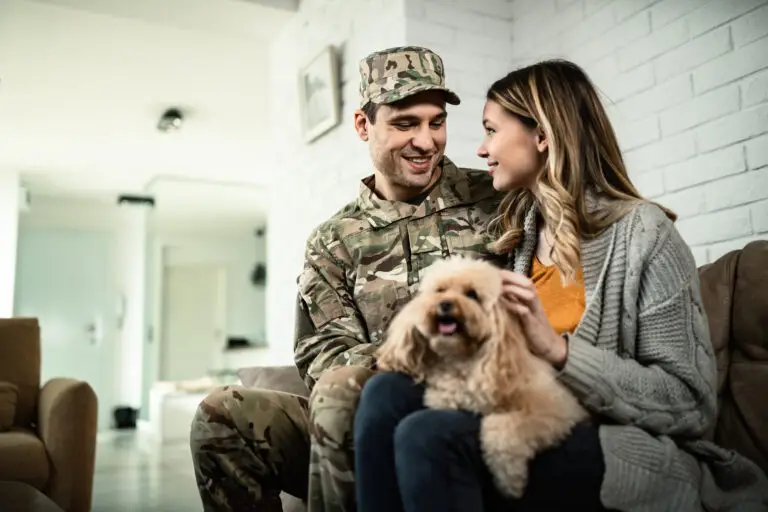

Can military spouses get vicarious PTSD? Yes — and many do, without realizing for years that what they have been carrying has a clinical name. Living closely with a service member who has been through combat exposes the spouse to a sustained version of the trauma that did not happen to them but has nonetheless changed how their nervous system operates. The nightmares, the jumpiness, the careful management of triggers around the house, the way you scan a parking lot for exits before he does — these can be signs that something has been transmitted across the relationship that neither of you intended.
This article is for spouses who have been wondering if their own symptoms are real, even though they were not the one deployed.
The Short Answer: Yes — military spouses can develop vicarious trauma (also called secondary traumatic stress) from sustained close exposure to a service member’s combat experiences, symptoms, and aftermath. It is clinically real and recognized, even though it has historically been understudied. Symptoms include intrusive thoughts about events you were not present for, hypervigilance, sleep disturbance, emotional numbing, avoidance, and the same threat-detection patterns the service member is running. It is not the same as direct PTSD — the diagnostic frame is different — but the symptom presentation overlaps substantially, and the treatment that works for direct PTSD usually works for vicarious PTSD too: trauma-focused therapy (CPT, EMDR, prolonged exposure) and, where appropriate, medication. The first step is recognizing that what you have been carrying counts.
If you are a Las Vegas-area spouse who suspects this is part of your picture, MindWell offers military spouse and family mental health. Call (702) 530-2549 or schedule online.
What Vicarious / Secondary Trauma Actually Is
Vicarious trauma — sometimes called secondary traumatic stress, indirect trauma, or trauma transmission — is the development of trauma symptoms in someone who was not the direct victim of the traumatic event but who has been exposed to it through close ongoing contact with someone who was.
The concept was first studied systematically in clinical populations: therapists who treated trauma survivors started developing symptoms that mirrored their patients’. From there, research expanded to first responders’ families, journalists who cover war zones, social workers, and — increasingly — military and veteran spouses.
The mechanism is not fully understood, but the working clinical picture is:
- Sustained close exposure to someone else’s trauma material — stories, sleep talking, nightmares observed by the spouse, behavioral changes, hyperarousal patterns
- The empathic engagement that comes from loving someone, which makes the exposure deeper than it would be for a stranger
- The ambient threat anticipation that comes from knowing your partner has been in danger and could be again
- Specific events that touched the spouse directly — notification visits, near-misses, the weeks waiting for a call, the homecoming from a hard deployment
Together, these can produce a nervous-system pattern in the spouse that looks remarkably similar to the one running in the service member.
How It Develops in Military Spouses
The military-spouse pathway to vicarious trauma is fairly specific.
Common contributing exposures:
- Living with the service member’s symptoms. If your husband came home with PTSD, depression, TBI, or substance use issues, you have been exposed to those symptoms daily for years — the nightmares, the irritability, the avoidance, the hyperarousal. That sustained exposure shapes you too.
- Direct accounts of deployment events. The stories he eventually tells you, in detail, when he is ready. The fragments that come out during arguments, in late-night conversations, after a few drinks. Each one lands.
- Specific notification and near-miss events. The chaplain knock that turned out to be the wrong house. The unit casualty report. The week he was unreachable while a major event was happening in his region. The midnight phone call from his battle buddy’s wife.
- Anniversary effects. Specific dates from his deployment that the family system marks — the day someone in his unit died, the day of a particular firefight, the date of a hard event. These can produce trauma reactions in the spouse even when the original event happened to the service member.
- Ambient hypervigilance over years. Living adjacent to threat-anticipation for a decade or more rewires the spouse’s own threat-detection systems even without specific trauma events.
The Specific Symptoms in Spouses
Vicarious PTSD in spouses tends to present with the same symptom clusters as direct PTSD, but with some distinctive features.
Intrusion symptoms
- Intrusive thoughts about events you were not present for, often in detail you constructed from his accounts
- Nightmares — often about the deployment scenarios he described, or about losing him
- Flashbacks or strong emotional reactions to triggers connected to the deployment material
Avoidance symptoms
- Avoiding war movies, news coverage, certain music, certain conversations
- Avoiding events on base that bring up the deployment material
- Difficulty discussing the deployment with anyone, including the service member
Negative changes in mood and cognition
- Persistent negative beliefs about the world (“nowhere is really safe,” “people you love can be taken instantly”)
- Survivor-style guilt — guilt about your relatively safe life when others did not come home
- Emotional numbing, detachment from people you used to feel close to
- Difficulty experiencing positive emotions
Hyperarousal symptoms
- Sleep disturbance, particularly waking with hypervigilance
- Exaggerated startle response — sounds, doors, sudden movement
- Difficulty concentrating
- Irritability that does not match the situation
- Scanning environments for threats — exits, unattended bags, suspicious vehicles
If you are recognizing yourself in this list, you are not “being dramatic.” You are describing a recognized clinical pattern.
How Vicarious PTSD Differs From Direct PTSD
The distinction matters clinically because it affects diagnosis, documentation, and sometimes treatment framing.
- The direct PTSD criteria require Criterion A — exposure to actual or threatened death, serious injury, or sexual violence. Vicarious exposure (learning about a trauma that happened to a close family member) can meet Criterion A under DSM-5, particularly when the trauma was violent or accidental — but the documentation is sometimes harder than for direct exposure cases.
- Some clinicians use “secondary traumatic stress” rather than PTSD as the formal label, because the picture is similar but the diagnostic frame is different. Both can be treated.
- The trigger landscape is different. Direct PTSD triggers tend to map onto the original trauma scene. Vicarious PTSD triggers tend to map onto relational material — the spouse’s stories, the home environment, the deployment cycle itself.
- Avoidance can shape the relationship in specific ways. A spouse with vicarious PTSD may avoid asking the service member about deployment for fear of triggering more material — which can lead to a pattern where neither partner can talk about it, even though both are carrying it.
PTSD treatment in Las Vegas covers treatment approaches for both direct and vicarious presentations. Combat PTSD treatment is built around the service member’s picture, but providers who specialize in combat PTSD typically also work with spouses experiencing the secondary version.
Why It Goes Undiagnosed for Years
Most military spouses with vicarious trauma are not diagnosed for years — sometimes decades. The reasons are structural:
- The framework is unfamiliar. Civilian providers may not know vicarious PTSD as a clinical category. Military spouses may not know it either, and so they do not bring it up.
- “You weren’t deployed” is the obstacle. Many spouses minimize their own symptoms because the original trauma did not happen to them. Some clinicians do too. The result is years of treatment for “anxiety” or “depression” without addressing the trauma layer underneath.
- The symptoms get folded into “stress” or “burnout.” A spouse with hypervigilance, intrusive thoughts, and sleep disruption gets told she is stressed. The deployment context gets noted but not treated as the source.
- The spouse protects the service member by not speaking up. Many spouses do not want to talk about how affected they are because they think it adds to his burden — particularly if he has his own untreated PTSD picture.
- Diagnostic momentum. Once “anxiety” or “adjustment disorder” is in the chart, providers tend to keep treating that picture rather than re-examining whether the underlying picture is actually trauma.
If you have been in mental health treatment for years for “anxiety” or “depression” with limited improvement, and you have a long military marriage with combat history, asking a provider to evaluate for vicarious or secondary trauma is reasonable.
How It’s Treated
The treatments that work for direct PTSD generally also work for vicarious PTSD.
Trauma-focused therapy
Cognitive Processing Therapy (CPT), Eye Movement Desensitization and Reprocessing (EMDR), and Prolonged Exposure (PE) are the three best-studied trauma-focused approaches. They are time-limited (typically 8-15 sessions) and structured around the trauma directly. For vicarious trauma in spouses, the “trauma material” is often the constellation of deployment-related events and the service member’s symptoms, rather than a single discrete event. Skilled trauma-focused therapists can adapt the protocols for this picture.
Medication where appropriate
SSRIs (sertraline, paroxetine) are first-line for PTSD generally, including vicarious presentations. Prazosin can help when nightmares are prominent. Sleep-targeted medications can support the sleep restoration that often has to happen before the deeper trauma work can land.
Couples or family therapy
When the trauma transmission is happening within an active relationship — particularly if the service member also has untreated PTSD — couples therapy that addresses both partners’ trauma pictures together can produce changes that individual therapy alone does not. The relational dynamic is part of the trauma system; treating it relationally is sometimes the highest-leverage move.
Peer support and community
Other military spouses who have been through this carry pieces that no individual therapist can. Support groups for military spouses dealing with combat-related family stress are available through the VA, the National Center for PTSD’s resources for family and friends, Military OneSource, and several non-profits.
Frequently Asked Questions
Is vicarious PTSD an official diagnosis?
Yes — DSM-5 PTSD criteria include indirect exposure (learning about a violent or accidental traumatic event that happened to a close family member) as Criterion A. Some clinicians use “secondary traumatic stress” as a separate but parallel framework. Both are recognized; both are treatable.
Can I have vicarious PTSD without my husband having PTSD?
Yes. The exposure that produces vicarious trauma includes the deployment context itself — the worry, notifications, near-misses, deployment cycle — not only the service member’s downstream symptoms. Spouses can develop trauma symptoms even when the service member came home and integrated well.
Will trauma therapy work for me even though it didn’t happen to me directly?
Yes. The same protocols (CPT, EMDR, prolonged exposure) work for vicarious presentations, with adjustments. Many trauma therapists are familiar with vicarious-trauma adaptations, particularly those who have worked with first responders’ families or military spouses.
Should I tell my husband I think I have this?
That is a personal call. Many spouses worry that the conversation will burden a partner who is already managing his own PTSD. Often the conversation is actually relieving for both — many service members suspected their spouse was struggling and did not know how to ask. Couples therapy can give the conversation a structured space.
Can our kids develop secondary trauma too?
Yes. Children of veterans with combat-related symptoms can develop their own trauma-influenced patterns — anxiety, sleep problems, hypervigilance, behavioral changes. The “intergenerational transmission of trauma” is a recognized pattern. Pediatric mental health resources, often through the VA family programs or military-specific child therapists, can help.
What if my symptoms are really bad — should I go to the VA?
The VA’s family programs include some support for military spouses, but treatment access for spouses through the VA system is limited. Most spouses end up using private psychiatric care, Tricare-covered providers, or Military OneSource as the primary path. For acute crisis: 988 (Veterans Crisis Line: 988 then press 1) is available 24/7 and serves family members of veterans, not just veterans.
MindWell offers military spouse and family mental health care in Las Vegas, including evaluation and treatment for vicarious and secondary trauma. The provider, Michael Kuron, is a former Navy Corpsman whose practice integrates care for both service members and their spouses.
Call (702) 530-2549 or schedule online. VA’s National Center for PTSD family resources are also available, and NIMH’s PTSD overview covers the broader clinical picture.
Related reading: Why Am I So Anxious Before My Husband’s Deployment? · How Do I Survive Solo Parenting During Deployment? · Is It Normal to Hate Being a Military Wife?
This article is educational and does not constitute medical advice. Mental health treatment should be individualized to the patient. If you are in crisis, call 988 (then press 1 for the Veterans Crisis Line for family members of veterans). Michael Kuron, MSN, APRN, PMHNP-BC is a board-certified psychiatric-mental health nurse practitioner and former Navy Corpsman serving the Las Vegas community.