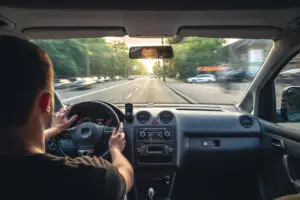

You’re stuck on I-15 between Sahara and Spring Mountain. You haven’t moved in six minutes. Your chest tightens. Your hands grip the steering wheel. You can’t see a way out of this lane. Your heart is racing, your breathing has shortened, and a thought breaks through: I have to get out of this car. If you’ve started panicking in Las Vegas traffic, you’re not weak, dramatic, or alone — and there are specific clinical reasons it happens here.
Panic in Las Vegas traffic is a real and treatable form of driving anxiety, often related to panic disorder, generalized anxiety disorder, or specific driving phobia (sometimes called vehophobia). The triggers are physiological (closed-in feeling, no escape route) and psychological (a fear-of-fear loop). Las Vegas traffic adds environmental pressure other cities don’t: the Strip’s stop-and-go, I-15’s high-speed merges, summer heat inside a stalled vehicle, and tourist drivers. The NIMH identifies panic disorder as one of the most common and most treatable anxiety disorders. Most people who get treatment see significant improvement within 8–12 weeks.
What’s Actually Happening During a Panic Attack in Traffic
A panic attack is a sudden surge of intense fear with physical symptoms that peak within minutes. Typical symptoms include:
- •Racing heart or palpitations
- •Shortness of breath or feeling like you can’t get enough air
- •Chest tightness
- •Sweating
- •Trembling or shaking
- •Dizziness or lightheadedness
- •Nausea
- •Feelings of unreality or detachment
- •Fear of losing control, going crazy, or dying
- •Tingling or numbness in hands, feet, or face
In traffic, all of this happens while you’re trapped in a moving box on a road full of other moving boxes. The combination of physiological arousal and physical inability to escape is what makes traffic panic uniquely intense.
Why Las Vegas Traffic Is Uniquely Anxiety-Provoking
The Strip and surface street density
Las Vegas Boulevard, Flamingo, Tropicana, and Sahara during peak times involve constant lane changes, pedestrian density, sudden brake checks, and turning conflicts. Every micro-decision is amplified for an anxious nervous system.
I-15 high-speed merges
I-15 between Tropicana and the 215 is one of the most dense merge sections in Nevada. High speed, multiple lanes, and unpredictable tourist drivers make this stretch a common trigger for driving anxiety.
The summer heat factor
June through September, surface temperatures regularly exceed 110°F. Being stopped in traffic — even with AC — creates a sense of being trapped that nervous systems read as threat. Heat amplifies physiological arousal.
Tourist drivers
Las Vegas has more out-of-town drivers per capita than most U.S. cities. Tourist drivers in unfamiliar areas — especially around the Strip — are unpredictable, adding to the cognitive load of every commute.
Long red lights at major intersections
The traffic light cycle on major Las Vegas intersections is often 2–3 minutes. For someone in early panic, that wait can feel impossibly long.
The Fear-of-Fear Loop
Most people who develop driving panic have had one or two attacks first, then started fearing the next one. This is called the fear-of-fear loop, and it’s the central mechanism that turns occasional panic into panic disorder. The pattern:
You have a panic attack in traffic (the first one).
It feels terrifying — you think you might die or lose control.
You start anticipating the next one every time you drive.
Your nervous system stays activated because it’s bracing for the threat.
That activation makes the next attack more likely.
You start avoiding certain roads, certain times, certain conditions.
The avoidance reinforces the fear and shrinks your driving range.
This is why driving anxiety often gets worse over time without treatment — the avoidance reinforces it. The good news: the loop is well-studied, and breaking it is what evidence-based treatment is designed to do.
Why It Feels Like a Heart Attack (And Isn’t)
Many people having their first panic attack in traffic are convinced they’re having a heart attack. The chest tightness, racing heart, shortness of breath, and arm tingling all overlap with cardiac symptoms. Many end up in Las Vegas ER’s getting cleared cardiologically.
- Peaks within 10 minutes
- Chest sensation = tightness/pressure
- Resolves once you’re safe and calm
- Triggered by psychological factors (stress, anxiety)
- Pain builds and persists
- Crushing pain, radiating to jaw or left arm
- Symptoms persist even when calm
- Triggered by physical exertion, often without warning
If you’re ever uncertain — especially during a first episode — get it medically evaluated. Cardiac causes need to be ruled out before any panic diagnosis is confirmed. The American Psychiatric Association recommends medical clearance for any first severe panic episode.
What Else Could Be Driving the Panic
Panic Disorder
If you’ve had multiple unexpected panic attacks and you’re starting to fear the next one, you may meet criteria for Panic Disorder. Highly treatable with CBT, exposure therapy, and/or medication.
Generalized Anxiety Disorder
Traffic panic can be one manifestation of broader anxiety. Treating the GAD addresses the traffic panic. See when to seek help for anxiety in Las Vegas.
Specific Driving Phobia (Vehophobia)
Some people have a specific phobia related to driving — often after an accident, near-miss, or witnessing one. The fear is focused on driving rather than being part of broader anxiety.
PTSD
If you’ve been in a car accident, post-traumatic stress can show up as driving panic. See our anxiety treatment overview.
Agoraphobia
Agoraphobia involves fear of situations where escape would be difficult — and being stuck in traffic is a prototypical agoraphobic trigger. Many people with panic disorder also develop some degree of agoraphobia.
What Actually Helps
Cognitive Behavioral Therapy
According to the Anxiety & Depression Association of America, CBT produces significant improvement in 70–90% of patients with panic disorder when completed.
Exposure therapy
Structured, graduated exposure to driving — starting low-stress, building up — is one of the most effective ways to break the fear-of-fear loop. Best done with a trained therapist.
Medication
SSRIs (sertraline, escitalopram, paroxetine) are first-line for panic disorder. Take 4–6 weeks for full effect. Benzodiazepines for acute episodes but not for long-term use due to dependency.
Breathing and grounding techniques
Diaphragmatic breathing, the 5-4-3-2-1 grounding technique, and progressive muscle relaxation can reduce acute panic in the moment. Work best when paired with longer-term treatment.
Practical Las Vegas adjustments
- ✓Avoid I-15 during the worst traffic windows if possible
- ✓Build in extra time so deadlines aren’t compounding the anxiety
- ✓Keep water and a cool pack in the car during summer
- ✓Stay off the Strip during peak tourist hours when alternatives exist
- ✓Avoid coffee or stimulants before high-anxiety driving
What an Evaluation in Las Vegas Looks Like
At MindWell Psychiatric Services, an evaluation for traffic-related panic includes:
- ✓A clinical interview about the panic attacks, their pattern, and their triggers
- ✓Screening for panic disorder, GAD, specific phobia, PTSD, and agoraphobia
- ✓Medical history review to rule out non-psychiatric causes
- ✓Discussion of medication and therapy options based on your specific picture
- ✓Coordination with primary care if medical clearance hasn’t already been completed
You can read about our anxiety treatment approach or learn about MindWell’s broader psychiatric services in Las Vegas.
When to Talk to a Psychiatrist
Make an appointment if:
- →You’ve had multiple panic attacks in traffic
- →You’re starting to avoid certain roads, times, or conditions
- →Driving is becoming a source of dread before it even happens
- →You’ve had to pull over, leave work early, or cancel plans because of driving panic
- →The anxiety is spreading from driving into other parts of your life
- →You’re using alcohol or other substances to manage the anxiety
You Don’t Have to Avoid I-15 for the Rest of Your Life
Driving anxiety is one of the most studied and most treatable forms of panic. With evidence-based treatment, most people can return to driving the roads they currently avoid — including the most stressful Las Vegas routes. The first step is naming what’s happening clinically so you can choose a treatment path. You can read what to expect at a first psychiatric appointment when you’re ready.